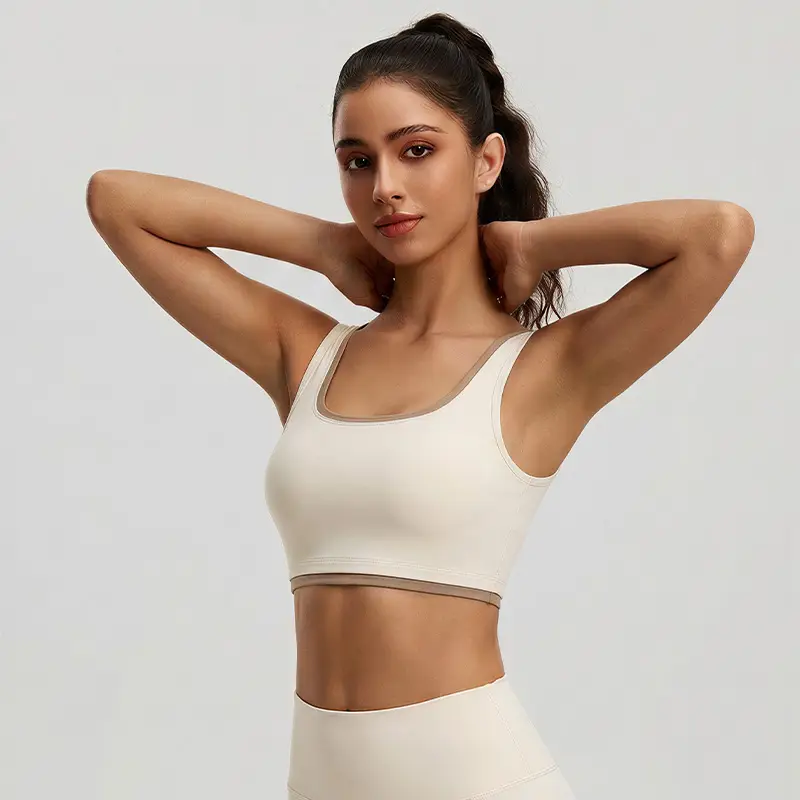
Fabric and elastic choices enter our sports-bra development process as production decisions, not isolated material selections. Our team links body fabric, underband tension, straps, cups, binding, and seam construction to the required support level and size range, then verifies the combination through sampling before the material specification is released.
For custom sports bras, we first define support, coverage, stretch, recovery, hand feel, drying behavior, and target sizing with the buyer. That brief allows our sourcing and sample teams to compare realistic material options against the same commercial target, shortening the path from fabric discussion to an approvable garment.
Evaluate Fabric and Elastic as One Support System
Reliable sports bra wholesale suppliers need control over the interaction between fabric and elastic. A stable underband cannot correct excessive stretch in the body fabric, and strong body fabric cannot offset straps or binding with poor recovery, so our development tests the assembled components through extension, movement, and basic wash evaluation.
Four-way stretch, moisture management, breathability, and hand feel are evaluated on the actual textile selected for the program. Nylon- or polyester-based stretch blends, recycled polyester options, and other performance materials can serve different price and feel targets, but our recommendation is based on tested weight, recovery, opacity, and finish rather than a generic fiber label.
Elastic selection begins with function. Underband elastic needs enough recovery to hold position without excessive pressure, shoulder straps must balance stability with comfort, and edge elastics should follow curves without creating rippling. The width, stretch ratio, softness, and attachment method all influence the finished garment, so those variables belong in the sample review.
Cups add another layer to the system. Fixed or removable cups change thickness, shape, drying behavior, and how the front panel responds during movement. We align cup type with neckline coverage, intended support, and washing expectations so the garment does not depend on one component performing a job it was not designed to handle.
Surface appearance matters, but it follows performance. A smooth matte fabric, brushed hand feel, or more technical sheen can support different brand directions, yet the selected textile still needs acceptable opacity, recovery, and dimensional stability across the expected size range.
Prototype Support Before Locking the Material Specification
Sampling allows material decisions to be tested on a real body shape rather than in isolation. We review underband tension, strap pressure, cup position, neckline security, side coverage, armhole shape, and back construction while the wearer stretches, bends, and raises the arms. This is where a promising fabric can reveal weaknesses that a swatch cannot show.
Our work at Joebond brings material choice directly into the customization workflow. Buyers can vary fabric and size plans, cup type, strap construction, elastic bands, labels, and logo methods while our sample team checks how those choices affect support, recovery, comfort, and production feasibility on the same garment.
A logo positioned near a high-stretch zone needs particular attention. Silicone marks, heat-transfer graphics, embroidery, woven labels, and reflective applications do not behave identically when the garment expands. We review scale, placement, edge comfort, adhesion, and recovery so brand identification does not interfere with function.
Color can change the way a material appears and sometimes the way it feels after finishing. Pale shades may make opacity easier to judge, while deeper colors can reveal differences in dyeing or surface finish. We compare approved color samples under the same stretch conditions used for the fit review.
The production specification captures the approved fabric code, elastic standard, cup type, measurements, stitch details, artwork, label placement, and packing instructions at the stage where they are settled. This gives material purchasing and sewing teams the information they need before volume increases, instead of postponing control until final inspection.
Carry Approved Materials Into Bulk Production
Bulk consistency depends on keeping material references visible after sampling. Incoming fabric, elastic, cups, and accessories need to match the approved standard closely enough that fit and support do not change between the sample and production. We connect material inspection with measurement and workmanship checks rather than treating them as separate quality tasks.
Repeat custom sports bras can return to the approved fabric-and-elastic combination without unnecessary redevelopment. If supply conditions require a substitute, our team resamples the replacement and checks the affected support and recovery points before accepting it for bulk use.
When buyers compare sports bra wholesale suppliers, material control at volume becomes a practical differentiator. We discuss required quantities and dye-lot continuity early enough to confirm that fabrics and elastics used for sampling can also support the intended commercial run.
Our Joebond production flow carries those material decisions into stitching, sizing, logo application, measurement, and final packaging checks. The advantage is continuity: bulk teams work from the same support and fit decisions that were approved during development.
A successful material choice should arrive at the production line already proven in the garment. By resolving support, comfort, durability, appearance, sourcing reliability, and manufacturability during development, our team gives the buyer a clearer route from sample approval to dependable volume.