Yoga apparel has become a significant part of the activewear market, creating more opportunities for brands, studios, and online retailers to develop specialized collections. According to Grand View Research, the global yoga clothing market was valued at $52.8 billion in 2025 and is projected to grow from $56.6 billion in 2026.
As more brands enter this market, choosing the right yoga wear manufacturer becomes critical to maintain product quality, scale production, and secure a reliable supply chain. This guide helps emerging athleisure brands, yoga studios, and e-commerce sellers identify the leading yoga wear manufacturers for custom OEM supply chain services and private label projects.
Why Manufacturer Choice Matters for Custom Yoga Wear
Selecting the right manufacturing partner can significantly influence product performance, customer satisfaction, supply reliability, and overall profitability. Understanding how factory capabilities align with your brand requirements helps reduce the risk of costly quality issues and supply chain delays before you place your first production order.
1. High Fabric Performance Standards
High-performance yoga clothing often prioritizes 4-way stretch for freedom of movement, reliable opacity, moisture management, and seam constructions such as flatlock stitching that can help reduce chafing during practice. Working with a specialized factory can also help improve shape retention, elasticity, and comfort after repeated wear and washing.
2. Supply Chain Scalability and MOQs
Flexible order volumes protect brand cash flow and reduce inventory risk. Low MOQs let startups test niche product lines, while large-scale production capacity supports seasonal replenishment without supply chain delays. A reliable manufacturer adjusts volume commitments as your brand grows.
3. Brand Identity Through Private Labeling
Private label athletic wear requires precise brand execution to stand out in the athleisure market. Custom woven tags, heat-transfer logos, customized waistbands, and branded packaging create a cohesive, premium unboxing experience. These customized touches build brand equity and increase customer loyalty.
Manufacturing Models Explained
Understanding production terminology ensures you select the correct supply chain structure:
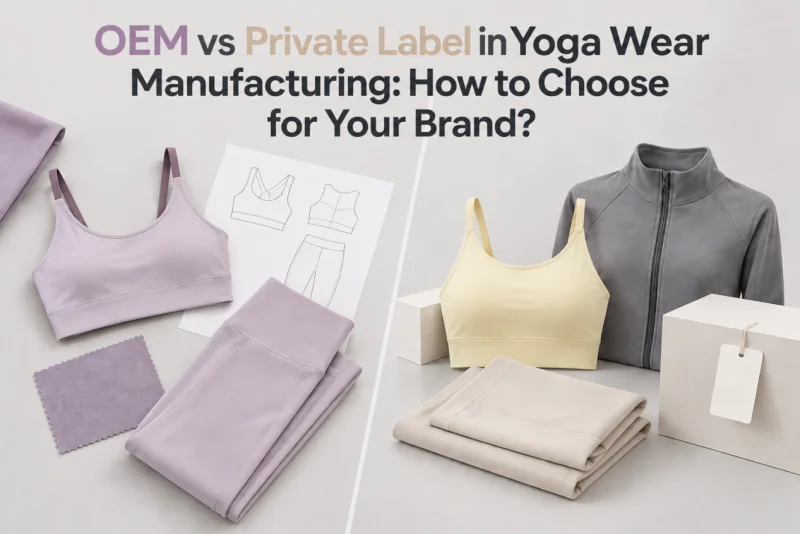
- OEM (Original Equipment Manufacturing):The factory builds clothing entirely based on your custom tech packs, pattern files, and material specifications.
- ODM (Original Design Manufacturing):The factory provides in-house designed garments, allowing you to select styles and modify specific details.
- Private Label Yoga Clothing:The manufacturer applies your custom brand logos, care labels, and packaging to existing factory designs or modified patterns.
- Ready-Stock / White Label: Pre-manufactured blank apparel available for quick logo printing and rapid market delivery.
Top 8 Yoga Wear Manufacturers for OEM & Private Label Projects
The following list is not ranked from best to worst. Each manufacturer serves a different sourcing profile, so the right choice depends on product complexity, MOQ, scale, sustainability requirements, and the level of development support you need.
| Manufacturer | Country | Manufacturing Model | Key Strength |
| JoeBond | China | OEM/ODM, private label, ready stock | Low-MOQ customization plus fast stock and bulk supply |
| Thygesen Textile Vietnam | Vietnam | Full-package OEM/ODM | Large-scale production and compliance infrastructure |
| Ohsurewear | China | OEM/ODM, private label | Flexible MOQ and niche activewear development |
| Scrod Industries | Pakistan | Custom manufacturing, private label | Very low MOQ for startup testing |
| Activewear Bali | Indonesia | Custom and ready-to-order | Recycled performance fabrics and boutique development |
| Eationwear | China | OEM/ODM, private label | Functional fabrics and scalable production |
| Hucai Sportswear | China | OEM/ODM | Clear development support for different project stages |
| Ingor Sportswear | China | OEM/ODM, private label | Digital production and scalable activewear manufacturing |
1. JoeBond — Flexible Customization With Ready-Stock Support
Procurement Positioning: Ideal for growing yoga brands needing an all-in-one partner for new product development, custom OEM manufacturing, and fast stock replenishment.
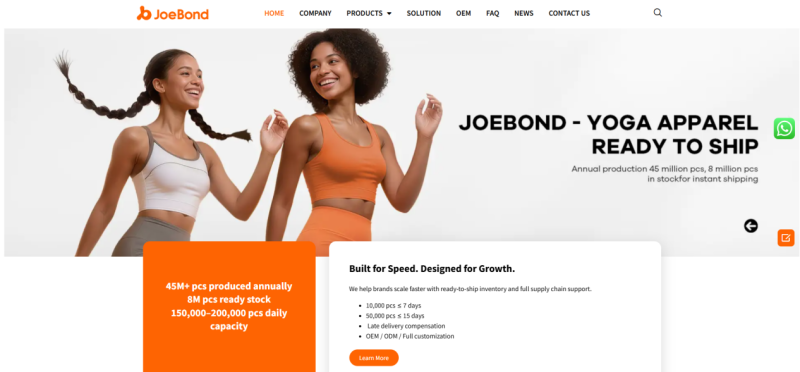
JoeBond is a specialized yoga and activewear manufacturer located in Zhejiang, China. With over a decade of industry experience, the company operates an integrated supply chain spanning fabric R&D, raw material sourcing, pattern making, sample development, and bulk manufacturing. They provide comprehensive OEM supply chain services, custom private labeling, and stock wholesale options.
⚡️Key Strengths:
- Vertical Supply Chain Integration:JoeBond connects fabric sourcing, pattern development, and assembly under a unified management process. This setup reduces communication overhead when creating custom yoga apparel.
- Hybrid Stock and Custom Supply:Maintaining approximately 8 million pieces in ready-stock inventory, JoeBond allows brands to test new markets using existing styles before transitioning to full OEM customization.
- Rapid Bulk Delivery:JoeBond states that 10,000-piece custom orders can be delivered within 7 days and 50,000-piece orders within 15 days, with late-delivery compensation available under its stated terms.
2. Thygesen Textile Vietnam — Built for Larger-Scale Programs
Procurement Positioning: Suited for established brands that need high-volume manufacturing capacity, structured quality systems, and documented international compliance support.
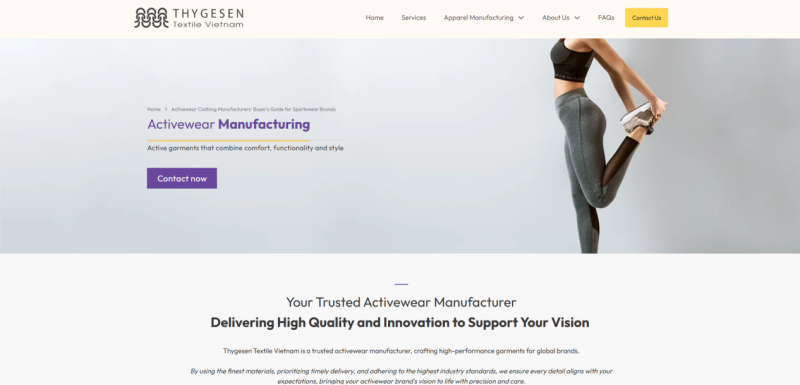
Thygesen Textile Vietnam operates as part of the Thygesen Textile Group, a Danish enterprise with textile origins dating back to 1931. The company provides full-package apparel manufacturing and product development services for international activewear and underwear brands.
⚡️Key Strengths:
- High-Volume Output:Facilities yield up to 800,000 pieces monthly, catering to brands operating established retail distribution networks.
- International Certifications:Factory certifications include ISO 9001, SA8000, WRAP, GRS, GOTS, and OEKO-TEX® STANDARD 100, providing documented support for brands with international sourcing and compliance requirements.
- Full-Package Development: Thygesen manages fabric selection, technical design, pattern adjustments, and sample creation based on initial brand concepts.
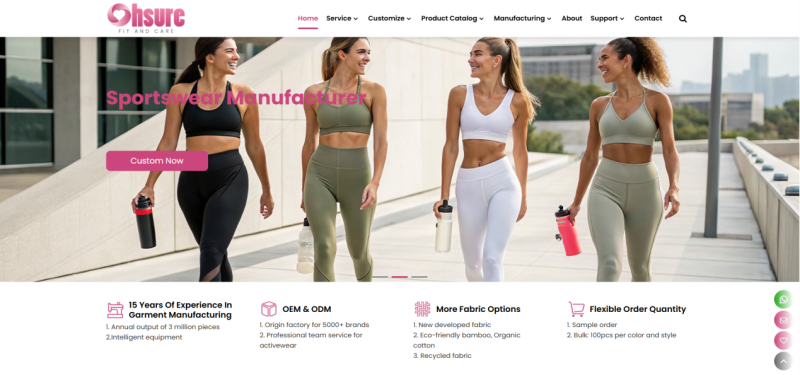
3. Ohsurewear — Flexible Orders and Niche Activewear Development
Procurement Positioning: A good fit for startups, growing activewear lines, and brands expanding into maternity, nursing, or adaptive fitness apparel.
Located in Dongguan, China, Ohsurewear was established in 2008 to provide sportswear customization, design development, and private label services. Alongside standard yoga apparel, the manufacturer specializes in functional activewear designed for pregnancy and nursing.
⚡️Key Strengths:
- Niche Product R&D:Dedicated design patterns account for body changes during pregnancy and nursing, offering specialized construction rather than simple size scaling.
- Accessible Order Minimums:Ohsure publishes a standard bulk MOQ starting at 100 pieces per style per color, with sizes mixed within that style-color combination, allowing emerging brands to test new designs with more controlled inventory exposure.
- Material Diversity:Options include nylon-spandex, recycled polyester, bamboo fiber, Tencel, and soft cotton blends.
4. Scrod Industries — Low MOQ for Early-Stage Brands
Procurement Positioning: Recommended for emerging startup brands seeking minimal initial production runs to test designs and manage cash flow.
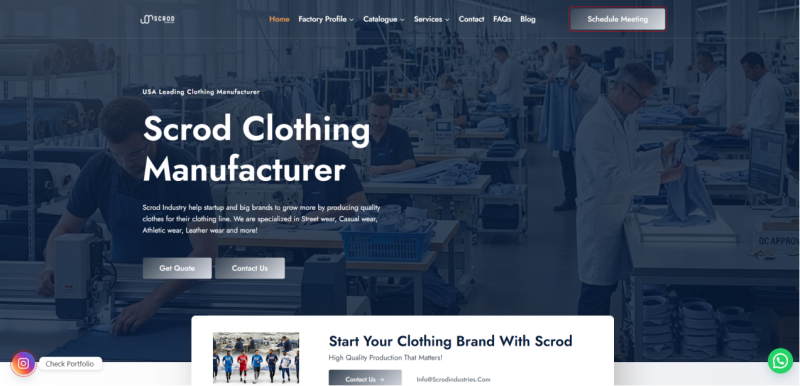
Based in Sialkot, Pakistan, Scrod Industries was founded in 2017 and supplies custom sportswear and apparel to international markets. Its manufacturing services cover fabric sourcing, pattern making, stitching, printing, embroidery, and private-label packaging.
⚡️Key Strengths:
- Ultra-Low MOQ Entry:The 20-piece minimum helps new brands conduct small-batch market tests with minimal inventory risk.
- Diverse Silhouette Range:Offers specialized fits including men’s yoga wear, plus-size lines, and modest athletic designs.
- End-to-End Processing:Handles fabric procurement, screen printing, custom woven labels, and final polybag packaging.
5. Activewear Bali — Recycled Fabrics and Boutique Activewear Development
Procurement Positioning: Designed for boutique yoga, Pilates, and athleisure brands prioritizing sustainable materials and technical fabric performance.
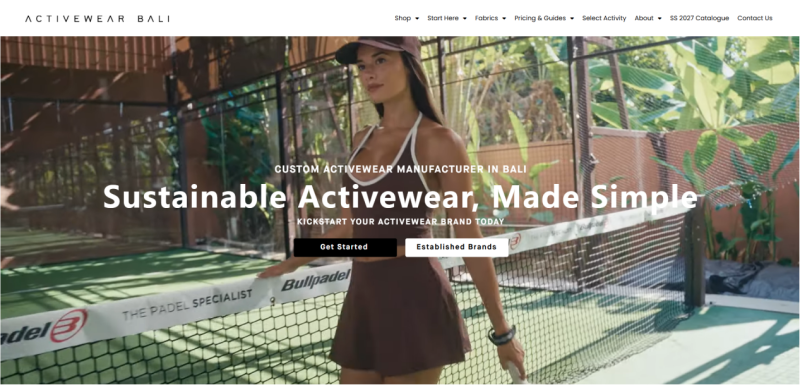
Activewear Bali operates as the specialized sportswear division of PT King Trading, producing functional activewear in Bali, Indonesia. The parent enterprise has manufactured garments locally since 1993, focusing on sustainable practices and high-end construction.
⚡️Key Strengths:
- Recycled Functional Textiles:Utilizes high-grade recycled nylon and polyester imported from South Korea and the U.S., offering shape retention and squat-proof opacity.
- In-Stock Fabric Color Library:Holds more than 85 activewear fabric colors in stock to support faster sampling and production.
- Digital Pattern Grading: Uses 2D AutoCAD pattern development to support accurate grading and fit consistency across repeat production runs.
6. Eationwear — Functional Fabric Options With Scalable Capacity
Procurement Positioning: Suited for mid-to-large activewear brands demanding advanced garment assembly methods, functional fabric choices, and stable bulk capacity.
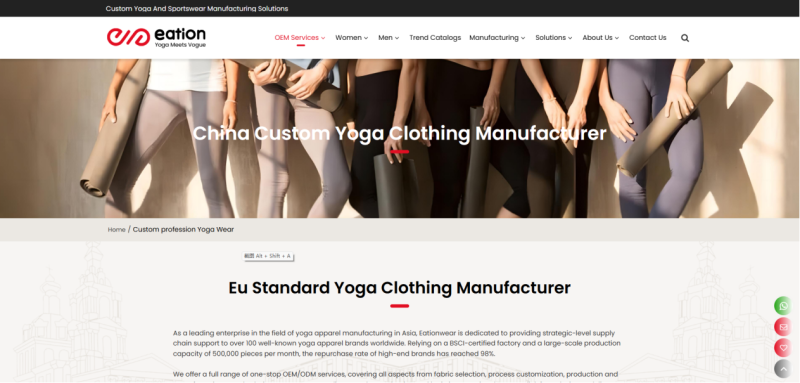
Eationwear is a Chinese sportswear manufacturer operating production bases in Guangdong and Guangxi. Its two factories cover a combined area of approximately 20,000 square meters and support end-to-end sportswear manufacturing.
⚡️Key Strengths:
- Advanced Assembly Methods: Uses seamless bonding and four-needle, six-thread stitching for performance activewear construction.
- Extensive Material Library:Access to over 200 functional knits, including Lycra, Nylon 66, and eco-friendly recycled fibers.
- Strict Quality Metrics:Employs an 8-stage inspection process and operates select production lines under AQL 1.5 quality standards.
7. Hucai Sportswear — Structured OEM and ODM Development
Procurement Positioning: Ideal for brands seeking clear, structured development options—whether bringing complete tech packs or building styles from rough sketches.
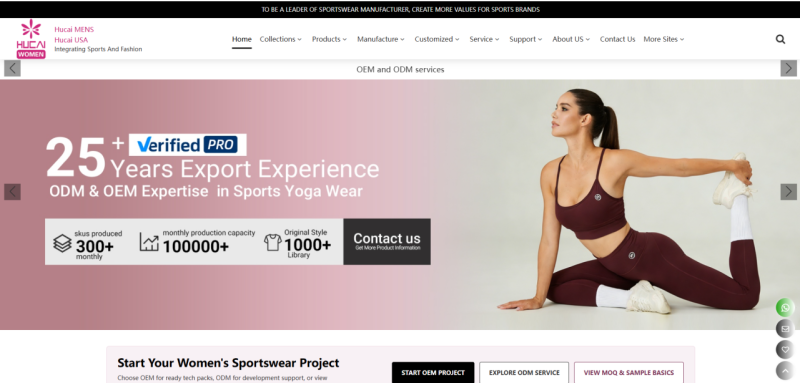
Situated in Dongguan, China, Hucai Sportswear has 25 years of experience in activewear manufacturing. The company serves markets including Europe, the USA, Australia, and the Middle East, providing custom pattern making, sampling, and bulk production.
⚡️Key Strengths:
- Dual Development Tracks:Brands with existing tech packs move directly to production, while early-stage businesses receive assistance in fabric selection and pattern design.
- In-House Technical Staff:Employs over 100 skilled workers, 15 technical staff, and 4 pattern makers, while using MES systems and smart equipment to support production management.
- Certified Manufacturing: Maintains factory compliance standards including BSCI, WRAP, OEKO-TEX, and GRS.
8. Ingor Sportswear — Digital Production and Sustainable Options
Procurement Positioning: Suited for scaling athletic brands seeking digitized order tracking, high monthly volume, and sustainable private label fitness clothing.
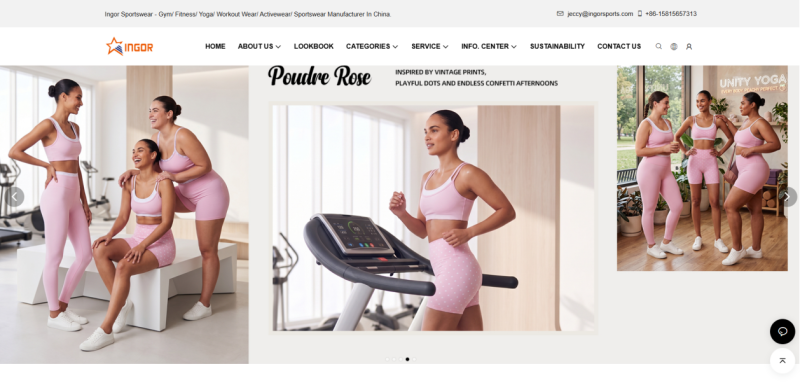
Founded in 2009 in Guangzhou, China, Ingor Sportswear operates a modern sportswear manufacturing enterprise with over 300 employees. The company provides end-to-end design, sampling, full-scale production, and custom private-label packaging to global athletic brands.
⚡️Key Strengths:
- Digitized Factory Operations: Utilizes Manufacturing Execution Systems (MES) and automated overhead hanging systems to monitor bulk production timelines.
- High Production Scale: Produces over 500,000 units monthly to support rapid brand expansion and reorders.
- Sustainable Material Options: Offers recycled nylon, recycled polyester, organic cotton, and other sustainable fabric options for custom activewear projects.
How to Evaluate a Yoga Wear Manufacturer Before Ordering
Selecting the right partner requires a systematic evaluation of factory capabilities:
1. Confirm the Manufacturing Model
Ask whether the quote covers OEM, ODM, private label, or ready-stock products. This determines how much design ownership and development work is included.
1. Test Yoga-Specific Performance
Check if the factory handles specialized activewear processes, such as flatlock stitching, heat-transfer logo application, moisture-wicking fabric finishing, and seamless bonding.
2. Match MOQ to Your Growth Stage
A low MOQ can reduce launch risk, but larger manufacturers may offer stronger economics or capacity once sales increase. Always clarify whether MOQ applies per style, color, fabric, or total order.
3. Review Sample-to-Bulk Consistency
Test sample garments for fit, opacity, seam stretch, and washing durability before placing a deposit on bulk orders.
4. Check Branding Support
Confirm which labels, heat transfers, hangtags, packaging, Pantone colors, and logo processes are available before approving the final quotation.
5. Assess End-to-End OEM Supply Chain Services
Strong sourcing relationships become more valuable as order complexity grows. Ask who controls material procurement, pattern making, production, inspection, packaging, logistics, and repeat-order planning.
FAQs
1. What Is the Difference Between OEM and Private Label in Yoga Wear Manufacturing?
OEM (Original Equipment Manufacturing) involves creating custom garments entirely from your proprietary designs, tech packs, and fabric selections. Private labeling involves placing your brand logos, tags, and custom packaging onto existing factory-designed garments or slightly modified patterns.
2. What Is the Typical MOQ When Manufacturing Custom Yoga Clothing?
MOQs vary by manufacturer and production model. Scrod Industries publishes a starting MOQ of 20 pieces per design, while Ohsure lists a standard MOQ of 100 pieces per style per color. For larger-scale production, Thygesen Textile Vietnam lists a bulk MOQ of 3,000 pieces per design, with different colors and mixed sizes.
3. Which Fabrics Are Most Recommended for High-Performance Yoga Leggings?
Nylon/spandex and polyester/spandex blends are common because they can combine stretch, recovery, durability, and moisture management. The correct blend and fabric weight depend on the desired compression, hand feel, opacity, climate, and price point.
4. How Long Does It Take from Sample Approval to Bulk Delivery for Private Label Activewear?
Production lead times vary widely depending on the manufacturer, fabric availability, customization level, and order volume. Facilities with active stock fabric programs, such as JoeBond, can deliver smaller bulk orders (e.g., 10,000 units) within 7 days.
Conclusion
Building a successful private label yoga brand requires a manufacturing partner that balances technical garment performance, low production risk, and scalable supply chain capabilities.
If you are looking for an OEM supply chain partner that combines custom activewear manufacturing with ready-to-ship inventory and scalable production, consult with JoeBond’s manufacturing team today to start developing your product line!