Choosing fabric for custom yoga leggings is not simply a matter of selecting nylon or polyester. Buyers must consider how the finished material stretches, recovers, handles moisture, remains opaque, and feels during extended wear.
A fabric may feel soft in a sample book but become transparent when stretched. Another fabric may provide firm compression but trap heat during intensive workouts. Therefore, B2B buyers should evaluate fabric according to the intended customer, activity, fit, and retail positioning.

Which Fabric Types Work Best for Custom Yoga Leggings?
The most suitable fabric blend depends on whether the leggings are designed for yoga, high-intensity training, casual wear, or compression-focused collections.
Common options include nylon-spandex, polyester-spandex, recycled versions of these blends, and brushed versions developed for a softer surface. However, fiber percentages alone do not predict the final performance because yarn construction, knitting density, finishing, fabric weight, and dyeing can change how the material behaves.
| Fabric option | Typical strengths | Points to evaluate |
| Nylon-spandex | Smooth hand feel, close fit, flexible movement | Pilling, drying speed, color consistency |
| Polyester-spandex | Low fiber moisture absorption, quick-drying potential, and sublimation-print compatibility | Surface feel, breathability, odor retention |
| Recycled synthetic blend | Supports sustainability-focused collections | Certification, consistency, traceability |
| Brushed fabric | Soft surface and comfortable casual feel | Heat retention, pilling, surface wear |
When Should Buyers Choose Nylon-Spandex Fabric?
Nylon-spandex is often suitable for yoga leggings that require a smooth surface, close body fit, and soft hand feel.
The nylon component can create a refined surface, while elastane or spandex provides the extension needed for bending, stretching, and floor-based movements. This combination is frequently considered for studio yoga, Pilates, athleisure, and premium-feel collections.
However, buyers should not approve nylon-spandex fabric based only on softness. A very soft fabric may pill after repeated rubbing or lose its original shape if recovery is insufficient.
For example, leggings worn during mat exercises experience friction around the knees, hips, and seat. Buyers should therefore compare abrasion resistance, pilling performance, recovery, and dimensional stability before confirming bulk production.
When Is Polyester-Spandex More Suitable?
Polyester-spandex may suit training leggings that use sublimation printing or prioritize low fiber moisture absorption, but the finished fabric still requires moisture-management and colorfastness testing.
Polyester absorbs relatively little moisture into the fiber itself. This characteristic can support quicker drying when the fabric construction and finish are properly developed. However, moisture performance still needs testing because the same fiber can behave differently across fabric structures.
Polyester fabrics may also support sublimation printing, making them relevant to collections with gradients, patterns, or repeated custom graphics. A buyer planning wholesale yoga leggings in several printed designs may therefore consider polyester-spandex for production efficiency and color reproduction.
The trade-off is that some polyester fabrics feel less smooth against the skin than comparable nylon fabrics. The supplier should provide several fabric qualities rather than presenting every polyester-spandex blend as interchangeable.
When Can Recycled or Brushed Fabrics Fit the Product Brief?
Recycled synthetic fabrics can fit collections that require documented material traceability, while brushed fabrics are more appropriate for softness-led or cooler-season products.
When choosing recycled fabric, buyers should request evidence supporting any recycled-content claim. Certification and supply-chain documentation are important because a generic material description does not confirm the origin or percentage of recycled fibers.
Brushed fabrics have a mechanically treated surface that creates a softer touch. This finish can work well for low-impact exercise, travel, casual wear, and colder environments.
However, brushing can influence pilling, heat retention, and long-term appearance. A brushed fabric intended for frequent studio use should therefore be tested after washing and repeated surface friction.
How Can Buyers Balance Stretch, Opacity, and Comfort?
Buyers can balance these three requirements by treating them as connected performance factors rather than separate fabric features.
Increasing stretch without controlling fabric density may reduce opacity. Increasing weight to improve coverage may make leggings warmer. Adding firm compression may support the body but reduce comfort when sizing or pattern measurements are not properly adjusted.
A practical development sequence should include:
- Define the intended activity and climate.
- Select the desired compression level.
- Compare fabric stretch in both directions.
- Evaluate opacity at the maximum intended extension.
- Test comfort on different body shapes.
- Approve the fabric together with the final pattern.
How Much Stretch and Recovery Do Yoga Leggings Need?
Yoga leggings need enough stretch for the intended movements and enough recovery to return close to their original dimensions after use.
Stretch describes how far a fabric extends under force. Recovery describes how effectively it returns after that force is removed. Poor recovery can result in loose knees, a sagging seat, or a waistband that becomes less stable over time.
Therefore, buyers should request controlled stretch and recovery results rather than accepting descriptions such as “high stretch” or “four-way stretch” without supporting measurements.
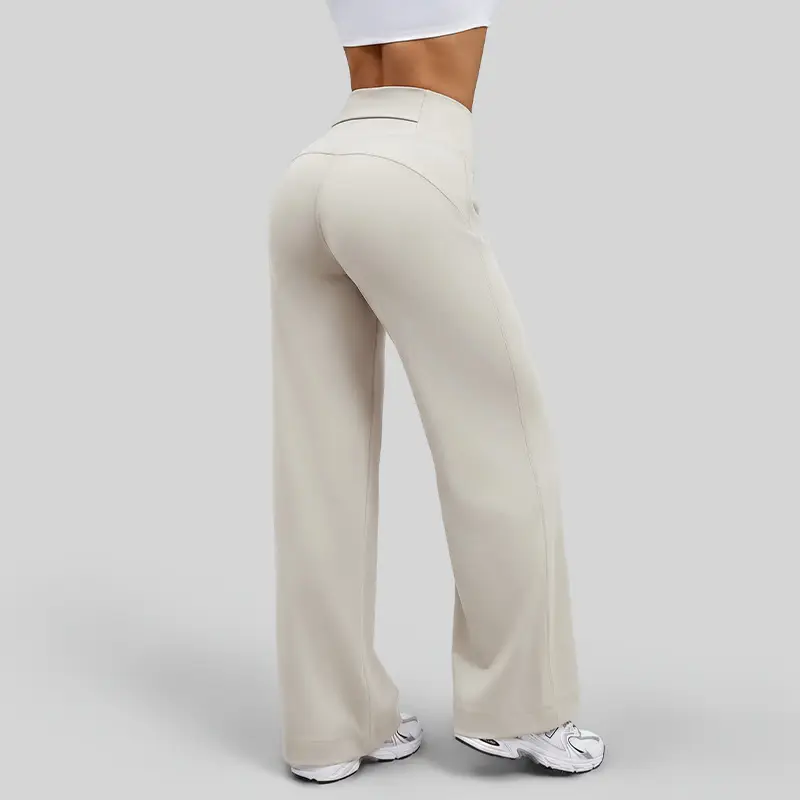
What Makes Yoga Leggings Opaque During Movement?
Yoga leggings remain opaque when their color, knit density, fabric weight, stretch limit, and garment sizing work together.
Opacity cannot be judged accurately while a fabric lies flat on a table. As the fabric stretches over the hips, thighs, and seat, the spaces within the knitted structure can expand and allow more light to pass through.
Light-colored leggings may require particular attention because reduced visual contrast can expose the body, underwear, or internal seams. However, dark fabric should not automatically be treated as opaque either.
A sourcing team should compare each colorway under consistent lighting and at the extension expected in the finished size range. Fabric should also be reviewed on an actual garment because an undersized pattern may place more tension on the material than a correctly graded pattern.
Buyers should avoid relying on the informal term “squat-proof” as a complete technical specification. Instead, the approval standard should describe the lighting, garment size, wearer measurements, movement, and acceptable level of visibility.
Which Fabric Properties Influence All-Day Comfort?
All-day comfort depends on surface feel, airflow, moisture movement, heat retention, compression, seam placement, and waistband pressure.
A fabric that feels pleasant for a few seconds may become uncomfortable after an hour of movement. For this reason, comfort evaluation should include sitting, walking, bending, and exercise rather than a simple hand-feel comparison.
Construction also matters. A wide waistband may distribute pressure more evenly, while poorly positioned seams may cause rubbing even when the base fabric is soft.
Therefore, buyers should evaluate fabric and garment construction together instead of expecting one material to solve every comfort issue.
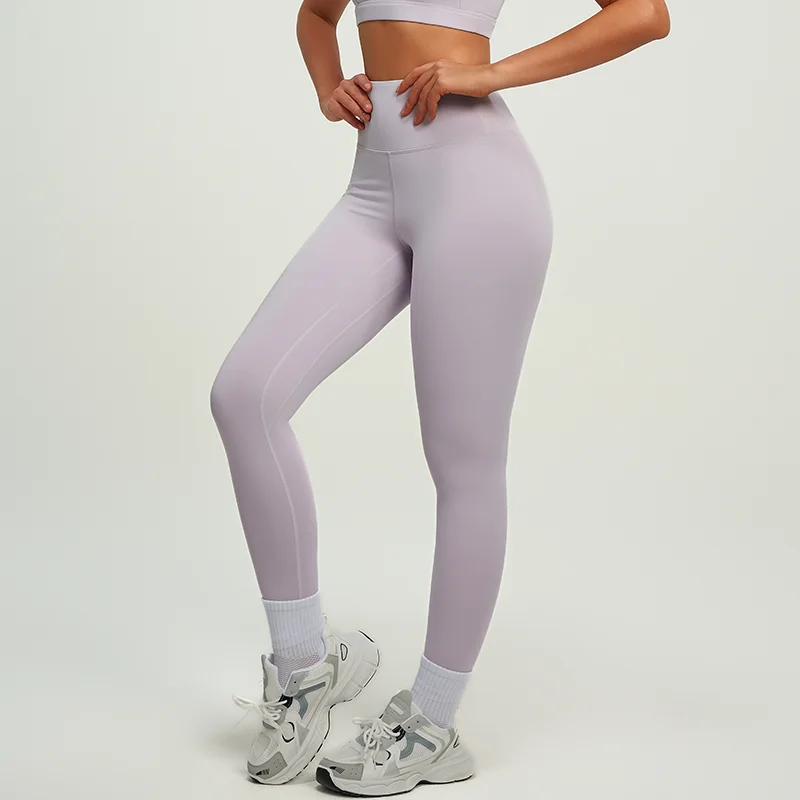
How Can the MT20-Peach Hip Yoga Leggings Guide a Private-Label Leggings Brief?
Once buyers have defined their targets for comfort, stretch, opacity, and compression, the MT20-Peach Hip Yoga Leggings can help translate those requirements into a practical private-label leggings brief.
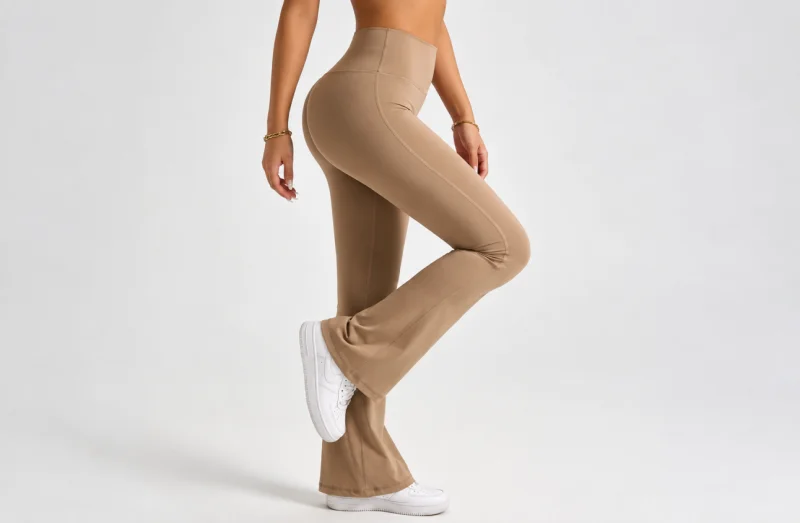
The MT20-Peach Hip Yoga Leggings provides a reference for a high-waisted, close-fitting style with a seamless-fit appearance, tummy-control construction, butt-lifting shaping, and a misty-blue color direction. Our product page describe the material only as stretchy and skin-friendly, so buyers should not treat the style as a fixed fabric formula. Instead, they can use its fit and wearing purpose to define the required hand feel, stretch recovery, opacity, compression, fabric weight, and moisture performance.
Buyers can choose between two sourcing routes. For faster market testing, ready-stock leggings can be ordered with lighter private-label changes, such as logo application, care-label replacement, wash-tag changes, and customized packaging. JoeBond states that the minimum order quantity for light customization of in-stock products is 100 pieces. For a more differentiated collection, buyers can use full OEM or ODM development to customize the fabric, pattern, fit, craftsmanship, and branding.
Production capacity and delivery requirements should also be written into the brief. JoeBond reports maintaining approximately 8 million pieces of ready stock and a daily production capacity of 150,000 to 200,000 pieces. The orders of 10,000 pieces can be completed within seven days and orders of 50,000 pieces within fifteen days, supported by more than 60 intelligent production lines. These capabilities may help buyers plan initial launches, seasonal orders, and faster replenishment, although the schedule for each style should still be confirmed before ordering.
For supplier qualification, We get ISO 9001, ISO 14001, and BSCI-certified systems on its OEM page. Buyers should confirm the validity and scope of the relevant documents, as well as the sample approval, inspection, and delivery requirements for their specific order.
In this way, the MT20-Peach Hip Yoga Leggings serves as more than a styling example. It helps buyers combine fabric and fit requirements with customization scope, order quantity, production capacity, and delivery planning before making the final fabric-selection decision.
Conclusion: How Should Buyers Select Fabric for Wholesale Yoga Leggings?
Buyers should select fabric by matching measurable performance with the intended activity, customer profile, design, and price positioning.
Nylon-spandex may suit smooth, studio-focused leggings. Polyester-spandex can support training products and printed collections. Recycled blends require traceable documentation, while brushed fabrics need additional attention to pilling and heat retention.
Regardless of fiber choice, buyers should examine stretch recovery, opacity under movement, airflow, surface durability, washing stability, and garment fit before approving custom yoga leggings.
More consistent results come from evaluating the fabric, pattern, seams, waistband, color, and size grading as one complete product. Working closely with an experienced yoga leggings manufacturer and providing a clear development brief can help brands reduce production risks and maintain greater consistency across a wholesale yoga leggings collection.