A branded sports skirt has to deliver movement and visual identity in the same garment. Our development work starts by identifying where the skirt flexes, where inner shorts provide coverage, how the waistband carries tension, and where a logo can remain clear without interfering with comfort.
With custom yoga skirts, we can combine pleats, panels, built-in shorts, stretch waist structures, or other styling details with performance fabrics. The branding plan is drawn into that construction from the beginning, which gives our team more control over placement, application method, and consistency across graded sizes.
Early coordination reduces unnecessary sample cycles. Silhouette, textile, branding technique, color, packaging, and the required production date are reviewed against one development schedule so the approved design can move into volume without last-minute decoration changes.
Choose the Skirt Structure Before Placing the Logo
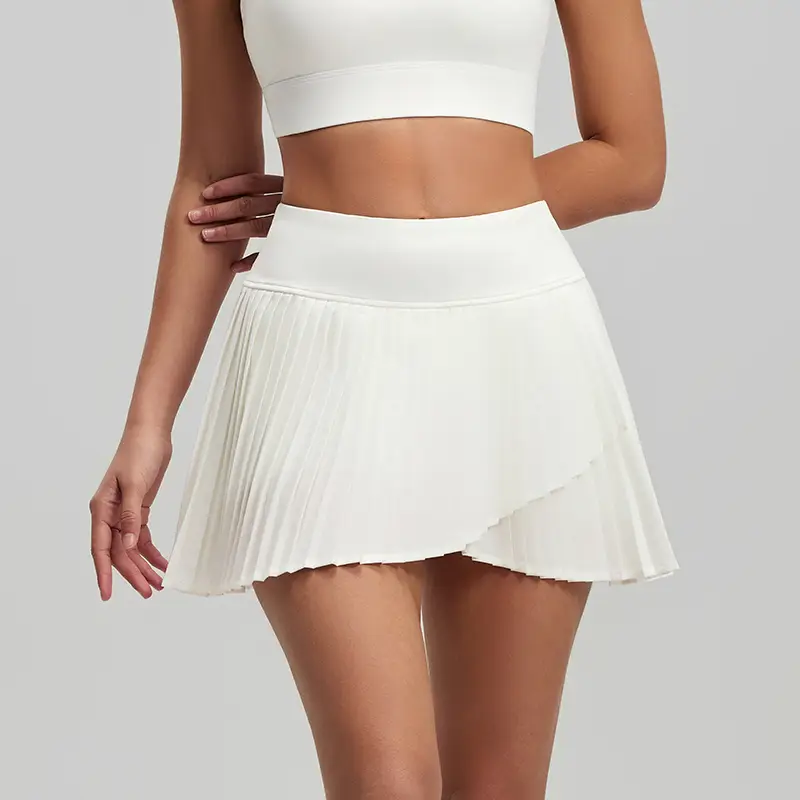
Different silhouettes create different branding zones. Pleated skirts move and fold through activity, skorts combine outer panels with inner shorts, and ruched or twist-front designs already contain strong visual lines.
For wholesale athletic skirts, pleat movement, waistband extension, built-in-short position, and pocket loading are reviewed against the selected logo zone before artwork dimensions are finalized.
The garment’s use case should guide the structure. Yoga and studio wear may prioritize flexibility and a smooth waistband, while tennis or running styles may need secure coverage and more dynamic movement.
We prefer to approve the logo on the actual skirt construction because the same artwork can look different when it crosses a seam, sits near a pleat, or is applied to a highly elastic panel.
Size grading also affects logo position. A mark placed too close to a seam can shift visually as the panel grows, while a centered design may need location rules rather than one fixed measurement. The tech pack should define placement from stable reference points so the artwork remains consistent across the size range.
Waistband design is another major decision because it anchors both fit and branding. A broad smooth waistband can create a stable surface for a discreet mark, while elasticized, folded, or highly contoured waist constructions may require different placement. Buyers should confirm that the waistband stays flat through bending and twisting before finalizing artwork that depends on precise alignment.
Pocket needs, inner-short length, and waistband construction should be defined at this stage because each element changes both movement and the available surface for branding.
Match Branding Technique to Performance Fabric
Custom yoga skirts commonly use nylon, polyester, spandex blends, sustainable materials, or other customized performance fabrics. Stretch, breathability, quick drying, and recovery are central to the garment, so the logo process should not create a stiff patch or compromise the fabric’s stretch. Testing the real artwork on the chosen textile is more reliable than approving technique from a separate sample card.
Heat transfer, printing, embroidery, woven labels, and other applications each create a different surface and production step. A small logo may tolerate more methods than a large graphic, while fine stretch fabric may call for a lighter treatment.
Buyers should evaluate edge quality, color accuracy, adhesion or stitch stability, and appearance after stretching and washing before releasing the design for volume production.
Branding extends beyond the visible mark. Hangtags, care labels, size labels, and custom packaging can support the same identity. When those components are developed alongside the garment, color and typography can be checked together and final packing is less likely to delay goods that are otherwise ready to ship.
The skirt workflow at Joebond allows us to support fabric selection, sample development, bulk production, quality inspection, and customized packaging. We coordinate those steps around the approved logo and garment specification so branding decisions remain connected to production control.
One production file should identify the final artwork, color standard, placement rule, fabric, and packing method so that the visual identity remains consistent through the order. A pre-production sample can verify that the final artwork still sits correctly after any late adjustments to pleats, panels, waistband height, or grading rules.
Move From Sample Approval to Scalable Production
The production path we use covers design consultation, fabric selection, prototype development, bulk manufacturing, inspection, packaging, and delivery. For skirt orders, Joebond lets us apply this sequence to both smaller batches and larger orders, allowing a brand to test a concept before expanding quantities.
Inspection for wholesale athletic skirts should cover stitching, sizing, fabric quality, appearance, logo accuracy, and the consistency of built-in or layered components. A buyer can also define tolerances for waistband dimensions, skirt length, inner-short length, pleat placement, and artwork position so that quality decisions are not left to visual judgment alone.
A scalable logo program depends on decisions that can survive bulk production. Silhouette, movement, fabric behavior, artwork placement, packaging, sample approval, and QC limits are converted into a production standard rather than left as separate design notes.
Later orders can restart from the approved artwork dimensions, pattern version, fabric reference, color standard, and packing setup. Our team confirms only the variables that changed, which protects the branded result while shortening the path to a repeat run.
Retail presentation should also influence the final specification. A skirt sold as a coordinated set may need color matching with bras, tops, or jackets, while a standalone style may carry more visible branding.
Planning these relationships before production also protects retail presentation. Coordinated sets can be checked for shade and logo consistency before photography and merchandising begin, while a future colorway can be introduced without reviving an obsolete placement or pattern.