Launching custom long sleeve shirts involves more than adding a logo to an existing garment. Private label brands must define the fit, fabric, construction, sizing, branding, and quality standards before asking a manufacturer to begin production.
A clear development process reduces repeated sampling, inconsistent sizing, and avoidable production delays. This guide explains how brands can turn an initial design idea into production-ready long sleeve yoga tops while maintaining control over product quality and brand positioning.

What Should Brands Decide Before Customizing Long Sleeve Shirts?
Brands should first define how the garment will fit, perform, and sit within the wider product range.
A long sleeve top designed for low-impact yoga has different requirements from a fitted training top or a loose studio cover-up. Therefore, the product brief should describe the intended activity rather than relying on broad terms such as “activewear top.”
Key decisions include:
- Fitted, regular, relaxed, or oversized silhouette
- Cropped, waist-length, or hip-length body
- Low-, medium-, or high-intensity use
- Base layer, standalone top, or outer cover-up
- Entry-level, mid-range, or premium retail positioning
Fit is particularly important for custom long sleeve shirts because sleeve length, shoulder width, armhole shape, and torso length affect movement at the same time. A shirt may look correct when standing but pull across the shoulders during forward folds or overhead stretches.
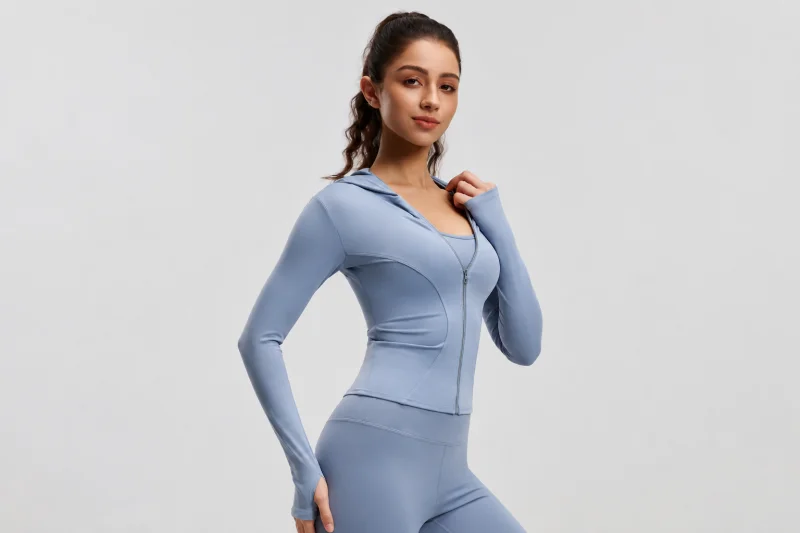
Brands should also decide how much coverage the garment provides. Thumb holes can extend hand coverage, while a half-zip collar allows the wearer to adjust ventilation. Cropped styles may suit fashion-led collections, whereas longer or looser silhouettes can support studio-to-street positioning.
A useful product brief connects every design feature to a practical purpose. For example, “add thumb holes for hand coverage during outdoor warm-ups” is more actionable than “make the sleeves functional.”
How Should Brands Choose Fabrics and Designs for Long Sleeve Yoga Tops?
Brands should choose the fabric only after defining the desired fit, stretch, coverage, and wearing environment.
Fabric composition alone does not explain how a finished garment will perform. Fabric weight, knitting structure, stretch direction, surface texture, recovery, opacity, and drape all influence the final result.
Which Fabric Properties Matter for Yoga and Training?
The fabric should stretch with the wearer and return close to its original dimensions after repeated movement.
Imp0rtant evaluation points include:
- Stretch in the width and length directions
- Recovery after extension
- Opacity during bending and stretching
- Moisture and heat management
- Abrasion and pilling resistance
- Colorfastness to rubbing, perspiration, and washing
- Hand feel against the skin
A fitted top usually requires reliable stretch and recovery so that the elbows, cuffs, and waist do not become loose after wear. A relaxed cover-up may prioritize drape, softness, and airflow instead.
Brands should request physical fabric swatches whenever possible. A digital fabric description cannot show whether a material feels slick, brushed, dense, lightweight, compressive, or transparent under tension.
Which Long Sleeve Style Fits the Intended Use?
The correct style depends on whether the collection prioritizes support, layering, coverage, or fashion differentiation.
| Style | Suitable positioning | Key points to evaluate |
| Fitted crew-neck top | Yoga, gym, base-layer use | Recovery, arm mobility, neckline comfort |
| Cropped long sleeve | Fashion-led activewear | Hem stability, coverage, proportions |
| Half-zip top | Warm-up and outdoor training | Zipper quality, collar comfort, ventilation |
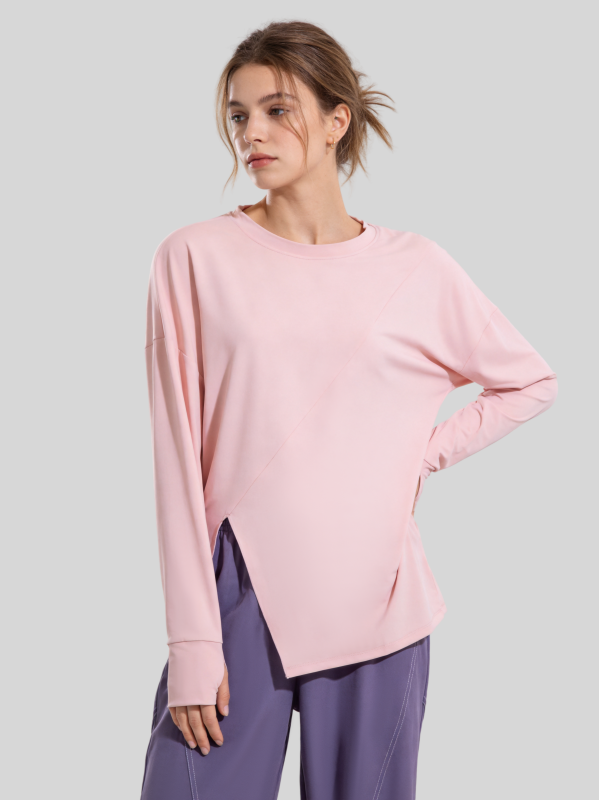
| Loose cover-up | Studio and casual layering | Drape, side openings, hem movement |
| Layered or built-in-bra top | Coordinated workout collections | Support, lining, cup placement, construction |
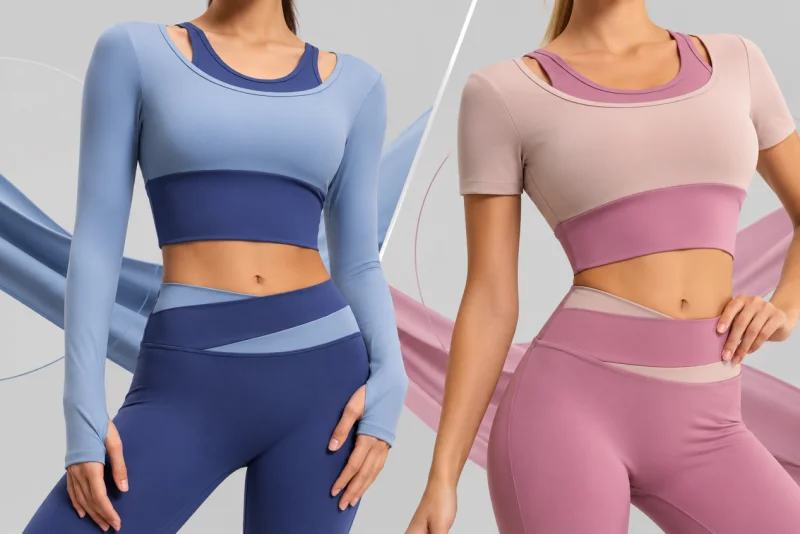
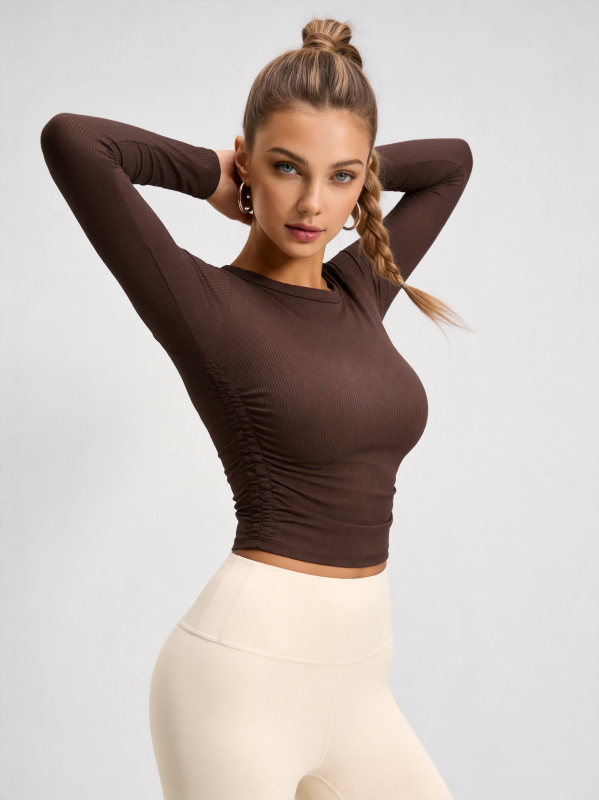
For example, JoeBond’s official range includes cropped square-neck tops with thumb holes and removable cups, two-in-one color-block tops with built-in support, half-zip styles, layered designs, and loose long-sleeve cover-ups. These examples show how long sleeve yoga tops can be differentiated through silhouette and construction rather than decoration alone.
Which Construction Details Affect Comfort and Durability?
Construction details should support movement without creating pressure or friction.
Brands should review seam placement around the shoulders, underarms, sides, and cuffs. Bulky seams may feel uncomfortable during floor-based exercises, while poorly shaped armholes can limit overhead movement.
Other details to define include:
- Neckline shape and binding
- Cuff width and sleeve opening
- Thumb-hole construction
- Hem finish
- Zipper length and backing
- Removable or fixed padding
- Internal lining
- Pocket placement
The phrase yoga tops long sleeve may describe many different products in search results, but buyers still need precise construction specifications to obtain the intended garment.
How Can Brands Evaluate Samples and Control Bulk Production Quality?
Brands should test samples as wearable products, not merely approve them from photographs.
A sample can match the sketch but still fail during movement. Therefore, sample evaluation should include fit sessions, repeated stretching, washing, and direct comparison with the measurement chart.
How Should Brands Test Fit, Stretch, and Movement?
Fit testing should reproduce the movements expected during actual use.
The wearer should raise both arms, rotate the shoulders, bend forward, perform lunges, and hold yoga poses. The review team should check whether the garment rides up, the cuffs twist, the neckline shifts, or the seams restrict movement.
A practical fit review includes:
- Static appearance
- Overhead reach
- Forward bending
- Shoulder rotation
- Elbow flexion
- Hem movement
- Opacity under stretch
- Comfort around seams and labels
The same sample should be measured before and after testing. This helps identify excessive fabric growth or garment distortion.
Which Fabric and Garment Quality Checks Are Important?
Quality checks should reflect the garment’s material, design, retail claims, and expected care method.
Useful checks may cover:
- Dimensional change after washing
- Colorfastness
- Pilling resistance
- Seam strength
- Zipper operation
- Stretch recovery
- Logo adhesion
- Cup or lining stability
- Measurement consistency
The brand should define acceptable results instead of asking whether the product “passed quality control.” A measurable standard gives the factory and inspection team a common reference.
What Should Be Approved Before Bulk Production Begins?
Bulk production should begin only after the final sample and production documents are approved.
The approval file should contain:
- Signed final sample
- Final measurement chart
- Approved fabric and color
- Confirmed labels and packaging
- Final logo placement
- Inspection criteria
- Purchase order details
Any change made after approval should be recorded in writing. Otherwise, the production sample, tech pack, and purchase order may contain conflicting instructions.
What Long Sleeve Product Options Does JoeBond Provide?
The JoeBond long-sleeve category provides reference styles for brands developing different collection positions.
The range includes fitted cropped tops, loose cover-ups, half-zip garments, layered tops, color-block designs, ruched backs, hollow-out details, thumb holes, removable cups, and fixed padding.
Private label buyers can use these styles as development references when discussing:
- Silhouette direction
- Coverage
- Neckline design
- Layering
- Support construction
- Sleeve and cuff details
- Decorative paneling
However, buyers should confirm the available fabric, size, color, minimum order quantity, branding method, sampling terms, and production schedule directly for each project. These details are not consistently published on the reviewed product pages.

How Does JoeBond Support OEM and Private Label Projects?
We support private-label brands through two sourcing models: ready-to-ship yoga and fitness apparel and customized OEM/ODM production. Our product range includes yoga tops, sports bras, jackets, leggings, shorts, and other activewear styles. Its product range covers yoga tops, sports bras, jackets, leggings, shorts, and other activewear styles, helping buyers build complete collections from one supplier.
For brands testing new markets or managing smaller orders, JoeBond maintains around 8 million ready-stock pieces for immediate shipment. Our annual output exceeds 45 million pieces, supporting larger order volumes..
For customized yoga apparel, JoeBond provides fabric selection, pattern development, sampling, logo application, packaging, and mass production. Our website lists production timelines of up to seven days for 10,000 pieces and up to 15 days for 50,000 pieces, with late-delivery compensation subject to the agreed project terms.. Its integrated textile, R&D, manufacturing, and supply-chain capabilities can also help buyers reduce sourcing costs and simplify project management.
Conclusion: How Should Brands Start a Custom Long Sleeve Shirts Project?
Brands should start by turning the product idea into a measurable specification before requesting samples.
Define the intended use, silhouette, fabric performance, construction, sizing, branding, labeling, and quality expectations. Then test the sample through realistic movement and washing before approving bulk production.
Well-developed custom long-sleeve shirts do not result from a single design decision. They result from coordinated choices across fabric, pattern, construction, testing, and manufacturing.
Our long-sleeve range gives private-label brands practical starting points for product development. A detailed tech pack and structured approval process can then help translate the selected direction into a production-ready garment.